
Overview
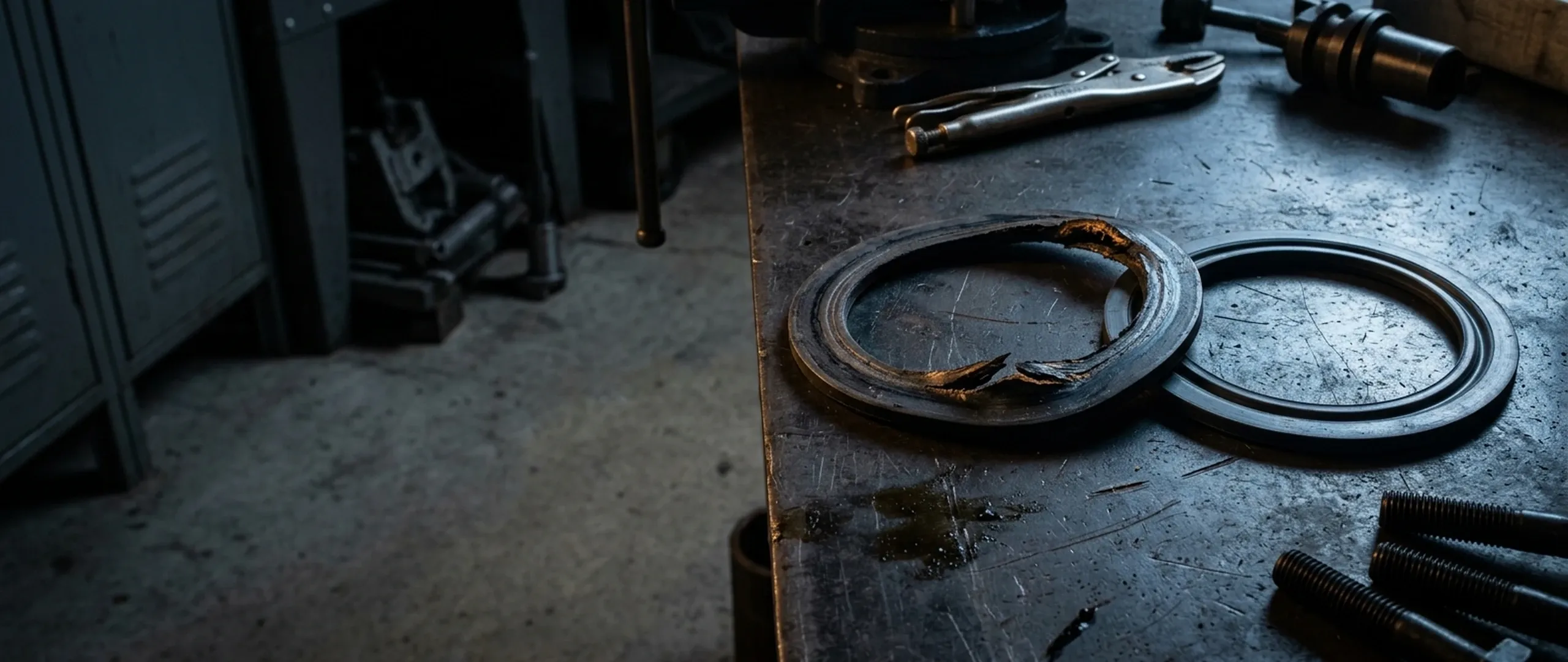
Gasket failures are rarely the gasket's fault. In the failed joints we examine, 80–90% trace back to installation, material selection, or flange condition, not to the sealing element itself. That lines up with manufacturer failure analyses, which put nearly 90% of gasket failures down to installation, bolt load, and flange condition. Knowing which mechanism you're looking at is the first step toward a permanent fix.
This guide walks through nine distinct failure modes, each with a cross-section diagram of what happens inside the flange joint. You can also use our Quick Diagnosis Reference to map the physical symptoms in front of you to the probable root cause.
Installation & Mechanical
Bolt-load and assembly failures — too little load, too much, load lost over time, and a gasket that was fitted twice.
Selection & Equipment
Material, environment, and flange-condition failures — chemical attack, heat, blow-out, surface damage, and misalignment.
What Industry Surveys Show
In a Pressure Vessel Research Council study of leaking flange joints, the causes broke down like this. Four of the five are the joint and how it was put together, not the seal.
- Improper installation 26%
- Flange damage 25%
- Gasket selection the seal 22%
- Loose bolts 15%
- Flange misalignment 12%
Add it up and only about one leak in five (22%) traces back to the gasket itself. The rest is installation, bolt load, and flange condition.
Engineering Insight
We get asked "why did my gasket fail?" more than almost anything else. Our answer is always the same: send us the failed gasket. Keep it, note which way it sat in the flanges, and photograph the flange faces before cleaning them. The deformation pattern, chemical staining, or thickness variation tells us exactly what went wrong.
Installation & Mechanical Failures
These account for the majority of leaks we investigate, and they all come down to bolt load. Too little, and the joint never seals. Too much, and you've destroyed the gasket. The right amount, applied correctly — but lost over time.
Under-Compression
The single most frequent cause of joint leakage. Insufficient bolt load means the gasket never beds into the microscopic irregularities of the flange faces, so media has a direct path out. Every material has a minimum seating stress (its ASME y factor) below which it will not conform. A compressed fibre sheet needs around 33 MPa to seat; soft rubber seals under 1.4 MPa. Pure under-compression is mostly a hard-material problem, or a gasket specified too hard for the bolts on hand.
Observed Symptoms
- •A visible gap between the gasket surface and flange face.
- •Active seepage, weeping, or spraying at the flange joint.
- •The removed gasket appears virgin and completely uncompressed.
- •Nuts and bolts are visibly loose or easily turned by hand.
Root Causes
- •Insufficient or uneven initial bolt torque.
- •Failure to execute a secondary re-torque after initial joint settling.
- •Incorrect cross-pattern tightening sequence leaving one side loose.
- •Specifying a gasket material far too hard for the available bolt load.
The Fix
- •Specify a material the available bolt load can actually seat: softer, lower seating stress, or ePTFE.
- •Check the gasket's seating stress against your bolts before ordering, not after the leak.
- •Torque to a written cross-pattern procedure, then re-torque once the joint settles.
Over-Compression
Excessive bolt load structurally crushes the gasket beyond its elastic recovery limit. The material splits, loses all resilience, and heavily extrudes radially. A crushed gasket cannot maintain a dynamic seal during operational thermal or pressure cycling.
Observed Symptoms
- •Gasket is visibly crushed flat or paper-thin in the primary sealing area.
- •Deep radial cracks running outward through the gasket body.
- •Material heavily extruding and bulging beyond the flange outer diameter.
- •Permanent deformation with an absolute loss of material spring-back.
Root Causes
- •Specified torque values heavily exceeded (severe over-tightening).
- •Uncontrolled, unmeasured use of impact tools or cheater bars.
- •Specifying a soft gasket material (e.g., standard rubber) for a high-pressure class flange.
- •Fitting a raised-face ring gasket to a flat-face flange, so the bolts sit outboard of the seal and tightening bends the flange (a cracking risk on cast iron).
The Fix
- •Step up to a material that takes the class's seating stress: compressed fibre, graphite, or a spiral wound, rather than soft rubber.
- •Control the torque with a calibrated tool. No impact guns, no cheater bars.
- •On a flat-face flange, fit a full-face gasket so the bolts clamp inside the seal, not outboard of it.
Creep & Stress Relaxation
This mode shows up in joints that were torqued perfectly at installation. Over time the gasket cold-flows under sustained stress; as it thins, the bolt load bleeds away and the joint eventually leaks. Around 10% of the initial load goes in the first 24 hours as the joint settles, which is the whole reason a re-torque matters, and elevated temperature speeds the rest. Virgin PTFE is the worst offender of the common materials.
Elastomers relax by a different route than fibre or PTFE. Rubber takes a permanent compression set (ASTM D395); fibre, PTFE, and graphite lose load by cold-flow creep (ASTM F38). Same lost clamp load, different mechanism and different fix.
Observed Symptoms
- •Joint was hydro-tested and verified leak-free at start-up, but leaked later in service.
- •Fasteners are found to be far below their initially specified torque upon re-checking.
- •The removed gasket is noticeably thinner overall than originally specified.
- •Complete absence of any chemical attack, burning, or physical blowout signs.
Root Causes
- •Using cold-flow-prone materials (e.g., virgin PTFE, thick soft rubbers) without accounting for relaxation.
- •Complete failure to execute a 24-hour or post-thermal-cycle scheduled re-torque.
- •Elevated process temperatures accelerating the material's natural creep rate.
- •Vibration backing the fasteners off over time. This is torque loss, a separate mechanism from gasket creep, but it drops clamp load the same way.
The Fix
- •Go thinner. A thinner gasket creeps and relaxes less than a thick one.
- •Swap virgin PTFE for a filled or expanded grade, or move to tanged/reinforced graphite.
- •Re-torque after a 24-hour dwell and again after the first thermal cycle.
Gasket Reuse & Compression Set
A gasket seals once. The first bolt-up crushes it into the flange finish and spends its recovery — the spring-back that lets it follow the faces. Refit the same gasket and it cannot re-seat: the material is thinner, work-hardened, and carries a permanent compression set. It is the most common false economy we see with soft-cut sheet and rubber.
Observed Symptoms
- •A bright, burnished witness ring where the gasket was clamped before.
- •Visibly thinner than a new one of the same spec, with no spring-back when pressed.
- •Leaks at low pressure straight after re-assembly, before any service time.
- •Cracks or splits running along the old compression line.
Root Causes
- •Refitting the old gasket to save a few dollars or a trip to the store.
- •Treating a soft-cut or rubber gasket as reusable. Once compressed, it is single-use.
- •No new gasket on hand at a shutdown, so the spent one goes back in.
- •Re-cutting a replacement off the old gasket, inheriting its wrong ID or OD.
The Fix
- •Always fit a new gasket. One that has been compressed once has spent its recovery.
- •Order to the correct ID, OD, and thickness so it seats square, not re-cut from a spent one.
- •Keep the right gaskets in stock for planned shutdowns so reuse is never the fallback.
Material & Environmental Failures
When we get a swollen, hardened, or chemically-eaten gasket back for analysis, the answer is almost always upstream — the material couldn't survive the service it was specified for. These are design-phase failures, not bolt-up failures.
Chemical Incompatibility
Chemical attack happens when the process media reacts with the gasket material. The result depends on the chemistry: the seal might swell, soften to a sticky paste, harden and crack, or dissolve altogether. Once the material's structural integrity is gone, the joint leaks.
Observed Symptoms
- •Heavy, unexpected discolouration or staining of the core gasket material.
- •Massive volume swelling (gasket appears twice as thick and feels mushy).
- •Gasket disintegrating, crumbling into powder, or turning to an adhesive paste.
- •Surface blistering, deep crazing, or severe embrittlement of elastomers.
Root Causes
- •Fundamentally wrong material specified for the baseline process chemical.
- •Failure to account for highly aggressive CIP (Clean-in-Place) acid/alkali flushes.
- •Unexpectedly high concentrations or temperatures exponentially amplifying the attack.
- •Trace tramp chemicals or system impurities reacting destructively with the elastomer.
The Fix
Match the polymer to the media, then confirm it against the data:
- •EPDM for steam, hot water, and many acids and alkalis (not oils).
- •NBR for oils and fuels (not ketones or ozone).
- •FKM for aggressive chemicals, solvents, and heat.
- •PTFE where you need near-universal chemical resistance.
Thermal Degradation
Operating a material past its rated continuous temperature destroys its structure. Elastomers bake hard and shatter like glass, PTFE cold-flows aggressively, and in non-asbestos fibre sheets the rubber binder degrades and oxidises, so the sheet loses strength and seal. As a rough guide, nitrile runs to about 120 °C, EPDM to 150 °C, FKM to 200 °C, and PTFE to 260 °C; flexible graphite handles far more but starts to oxidise in air from around 450 °C. Rapid thermal cycling compounds all of this by loosening the flange bolts.
Observed Symptoms
- •Gasket is rock hard, perfectly brittle, snapping audibly upon removal attempts.
- •Material looks visibly charred, burnt, deeply discoloured, or entirely black.
- •Heavy geometric cracking present with no visible signs of mechanical crushing.
- •Joint fails suddenly and catastrophically immediately after a thermal shutdown/startup cycle.
Root Causes
- •Continuous operating temperature well above the material's rated threshold.
- •Unaccounted temperature excursions (e.g., steam flushes, process spikes).
- •Rapid thermal cycling causing flange expansion and bolt loosening.
- •Using standard rubbers or basic fibres where the duty calls for graphite or high-temp alloys.
- •Operating beyond the flange's pressure-temperature rating — the class may permit the temperature, but not at the concurrent operating pressure.
The Fix
- •Move up the temperature ladder the duty needs: elastomer, then compressed fibre, then flexible graphite or PTFE, then spiral wound.
- •Confirm the flange's pressure–temperature rating at the concurrent pressure, not the temperature alone.
Extrusion (Blow-out)
High bore pressure pushes soft gasket material outward, trying to force it past the flange faces. Sometimes the extrusion is gradual — a slow creep over weeks. Other times the material blows out in a single event, and you've got a major leak on your hands.
Counter-intuitively, a thinner gasket resists blow-out better than a thick one: there is less material to extrude and it seats at a higher stress. Only go thicker to bridge a damaged or uneven flange. On spiral wound gaskets, an inner ring stops the windings buckling into the bore; ASME B16.20 requires inner rings on all PTFE-filled spiral wounds.
Observed Symptoms
- •Gasket material distinctly protruding inward past the flange ID into the pipe bore.
- •The inner diameter is heavily torn, raggedly frayed, or physically "nibbled" away.
- •Complete missing sections of the gasket body indicating a sudden blowout.
- •Unexplained gasket fragments found caught in downstream filters, pumps, or control valves.
Root Causes
- •Operating pressure exceeds the gasket's burst strength rating.
- •Excessive clearance between the flange ID and the gasket ID.
- •Gasket material too soft or too thick for the operating pressure.
- •Using Spiral Wound Gaskets without inner rings in high-pressure or vacuum service — a common oversight we see.
The Fix
- •Go thinner and harder or reinforced: tanged/reinforced graphite, or filled PTFE over virgin.
- •Get the gasket ID-to-bore clearance right so there is less lip to extrude.
- •Fit inner rings on spiral wound gaskets. ASME B16.20 makes them mandatory on all PTFE-filled ones.
Equipment & Flange Condition
Even the best gasket won't seal a damaged flange. Scratched faces, corroded surfaces, and pipe misalignment are equipment problems — no gasket material can compensate. Fix the flange first, then install the new seal.
Flange Surface Damage
Deep gouges, scratches, chemical pitting, and heavy corrosion on the flange face create leak paths that soft gaskets can't bridge. Radial scratches are the worst — running from inner diameter (ID) to outer diameter (OD), they give the media a direct escape route across the sealing face. In our experience, a single deep radial scratch is enough to kill the joint.
That face is meant to carry a serrated, phonographic finish. ASME B16.5 calls for 125–250 µin Ra (about 3.2–6.3 µm). That controlled roughness is what grips a soft gasket, and a wire wheel destroys it. Paint, grease, or old gasket residue on the seat is a leak path in its own right, so clean and inspect the face before every install.
Observed Symptoms
- •Highly visible deep scratches, aggressive tool marks, or sharp scoring on the flange face.
- •Heavy rust pitting or deep eroded fluid channels present across the primary sealing area.
- •The freshly removed gasket visually shows an uneven, wavy impression contact pattern.
- •The leak is localised strictly and persistently to one very specific point around the joint.
Root Causes
- •Aggressive gasket removal — prying with screwdrivers or chisels gouges the face.
- •Using hard wire wheels that destroy the flange's phonographic finish.
- •Galvanic corrosion or prolonged media erosion acting directly on the exposed metal.
- •Trapped foreign debris, old gasket material, or hard weld spatter compressed during assembly.
The Fix
- •Re-face or skim the flange back to the ASME B16.5 serrated finish (125–250 µin, about 3.2–6.3 µm Ra). That roughness is what grips a soft gasket.
- •For minor surface damage, a softer or thicker soft-cut gasket can bridge what a hard gasket cannot.
- •Clean paint, grease, and old gasket residue off the seat before every install. Never wire-wheel it.
Flange Misalignment
When flanges aren't parallel or concentric, tightening the bolts forces the gasket to compress unevenly — crushed on one side, gaping on the other. The bolts take uneven load too, and the loose side will leak. Every time.
Observed Symptoms
- •Physical flange gap is visibly and severely inconsistent around the entire circumference.
- •Nuts resist tightening heavily on one specific side compared to the loose opposite side.
- •Gasket is crushed paper-thin on one side, barely touched or completely unmarked on the opposite.
- •Massive heavy flanges "spring" apart violently and dangerously when unbolted.
Root Causes
- •Pipe strain from a poorly routed system pulling the joint out of alignment.
- •Uncompensated thermal expansion in long straight piping runs.
- •Foundation settling in older plant, or structural movement of connected equipment.
- •Rushed pipe fabrication or welding leaving the assembly permanently bent.
The Fix
- •Correct the alignment at the piping level before you bolt up. Never pull flanges together with bolt tension.
- •Check flange parallelism to ASME PCC-1 before bolt-up.
Prevention
Misalignment must be corrected at the piping level before bolting — never force-align flanges with bolt tension. Our Flange Installation Guide covers proper alignment verification, acceptable tolerance limits, and the correct bolt-up sequence to ensure uniform gasket compression.
Less-Obvious Causes
A handful of failures we still see that don't get their own diagram. Each is worth a two-minute check before you bolt up.
Off-Centre or Wrong-Size Install
A gasket cut to the wrong ID or OD, or fitted off-centre, only seals across part of its width. The exposed edge sees full pressure with no support behind it. Cut it to the flange, and centre it on the bolts rather than by eye.
Aged or Perished Stock
Rubber and elastomer-bound sheet have a shelf life. Ozone and time harden them on the shelf, so a gasket cut from old stock can crack on first compression. Check the age of sheet stock before cutting a critical joint.
Double Gasketing
Stacking two gaskets to cure a weep never works. The pair compresses unevenly and overloads the bolts, and you now have two interfaces to leak instead of one. Never stack gaskets; find the real cause.
Erosion at the Bore
Fast or particulate media scours the exposed inner edge, nibbling it back over time. It looks like extrusion, but the driver is flow, not pressure. A harder facing or a recessed ID helps where the media is abrasive.
Painted or Contaminated Faces
Paint, grease, or old gasket residue on the seat holds the faces apart and is a leak path in its own right. This is the classic lubrication-interference failure. Clean the face back to bare, sound metal before every install.
Quick Diagnosis Reference
Use this high-contrast reference to rapidly cross-reference your specific visual findings with the single most likely failure mode.
Installation & Mechanical
Under-Compression
Visible gap; loose bolts; absolutely no gasket compression.
Review bolt torque records & tightening procedures
Over-Compression
Gasket visibly crushed flat, split radially, or extruding.
Check applied torque vs gasket material physical limits
Creep & Relaxation
Tight initially, but leaks later; gasket notably thinner.
Implement mandatory 24 h or post-cycle re-torque schedule
Gasket Reuse
Burnished witness ring; thinner than new; leaks at low pressure right after re-assembly.
Always fit a new gasket; a compressed one has spent its recovery
Material & Environment
Chemical Attack
Swollen, sticky, mushy, or completely dissolved into fluid.
Verify all chemical compatibility data rigorously
Thermal Degradation
Rock hard, brittle, charred, snapped directly in half.
Review max operating temps & thermal excursions
Extrusion / Blow-out
Material missing from ID, torn, or blown clean out.
Upgrade material strength or use integral inner rings
Next Steps
Once you've identified the failure mode, fixing it is usually straightforward. These two starting points cover most situations we see.
Talk to Our Engineers
Send through photos of the failed gasket, the flange faces, and your service conditions — media, temperature, and pressure. One of our engineers will tell you what they're seeing and what to try next.
Browse Technical Library
Installation guides, chemical compatibility charts, and material selection tools — all in one place. Start with the topic that matches your failure mode.
Explore Further
Disclaimer
This guide is provided for general engineering reference only and does not constitute professional advice, specification, or guarantee of performance. Actual results depend on specific application conditions. Universal Gaskets Pty Ltd accepts no responsibility or liability for decisions made based on this information. For full terms, see our Terms & Conditions.