
Spiral Wound Gasket Guide
Specifying the wrong style or misreading a colour code costs more than a shutdown. Anatomy, ASME B16.20 identification, style selection, and technical specifications — everything you need to get it right.
Anatomy of a Spiral Wound Gasket
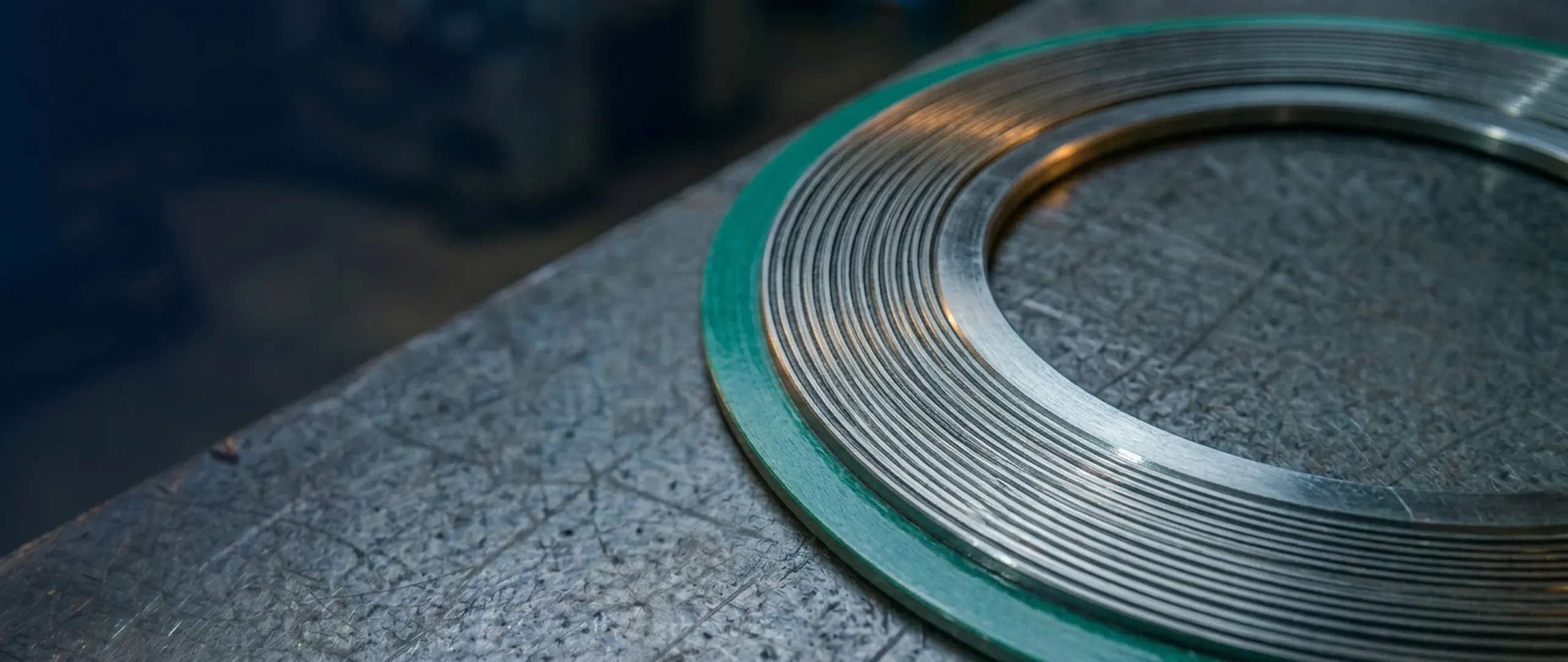
A spiral wound gasket (SWG) is a semi-metallic sealing element built from alternating strips of metal and soft filler material, wound in a spiral. The result is a gasket that behaves like a spring while conforming to the flange face. That spring-back recovery is why we specify it as the default for raised face flanges from Class 150 upward. Above Class 600, it becomes the only practical option — sheet gasket creep at those stress levels is a seal-integrity problem, not a maintenance inconvenience. For a broader view of how SWGs fit into the gasket landscape, see our Gasket Selection Guide.
Radial Cross-Section (CGI Style)
Outer Ring
Centring / Guide Ring
A solid metal ring (typically carbon steel, painted or coated) that centres the gasket between the bolt holes on a raised face flange. Acts as a compression limiter to prevent over-tightening.
Sealing Element
The Winding
Alternating layers of V-shaped (chevron) metal strip and soft filler material wound in a spiral. The metal provides spring-like resilience; the filler conforms to flange surface imperfections and creates the seal.
Inner Ring
Anti-Buckling Ring
A solid ring fitted inside the winding element. Prevents the windings from buckling inward under excessive bolt load (the dreaded "bird's nest"), shields the winding from process media erosion, and reduces turbulence at the bore.
Workshop Note
In our manufacturing facility, we see a clear trend: customers who initially order Style CG gaskets for cost reasons often switch to CGI within a year after experiencing a winding buckling incident. Specify CGI from the start for any of these: above 300 °C, pressure cycling, vacuum service, or toxic/flammable media. The inner ring adds minimal cost — a buckling incident adds much more.
The Winding: How It Seals
The sealing element is what makes a spiral wound gasket unique. Understanding how the winding seals — and recovers — explains why it maintains seal integrity through thermal cycling where sheet gaskets develop permanent set and leak.
Chevron V-Shape Detail

Construction
A pre-formed metal strip (typically 0.15–0.23 mm thick) winds outward in a continuous spiral from the inner diameter. A strip of soft filler material winds in simultaneously, filling the gaps between the metal V-shapes. The result is a gasket that behaves like a series of concentric springs with integrated sealing.
Inner & Outer Pillows
Not all winding turns carry filler. The first few turns at the ID and the last few at the OD use metal strip only — no filler. These reinforcement zones form what we call pillows:
- Outer pillow — Provides structural attachment to the outer centring ring and prevents the sealing element from unravelling. Typically spot-welded to the ring.
- Inner pillow — Reinforces the ID of the winding against inward buckling and provides attachment to the inner ring (when fitted).
The number of pillow turns affects gasket density. Standard-density gaskets have more metallic wraps per unit width for greater structural integrity. Low-stress designs use fewer, wider-spaced wraps for lower seating loads.
The Sealing Mechanism
- Bolt load compresses the V-shaped windings, narrowing the chevron angle and forcing filler material into intimate contact with the flange faces.
- Internal pressure acts radially on the windings, tending to straighten the V-shapes. This generates increasing sealing force as pressure rises — the self-energising effect.
- Thermal cycling causes flanges to separate and re-close. The spring-like metal windings recover, maintaining seal contact where a sheet gasket would develop a permanent set and leak.
Workshop Note
The V-shape tips must slide freely across the flange face during compression. If the flange finish is too rough (above 6.3 µm Ra for general service), the tips snag and the winding buckles instead of compressing. Always check flange finish before fitting an SWG.
Why Semi-Metallic?
Spiral wound gaskets sit between soft-cut gaskets (rubber, fibre) and hard metal gaskets (ring type joints). They handle higher pressures and temperatures than soft gaskets while requiring significantly less bolt load than Ring Type Joint (RTJ) gaskets. That combination makes them the default for the vast majority of ASME B16.5 flanged joints. See our Pressure-Temperature Ratings guide for full ASME B16.5 derating curves across material groups and pressure classes.
Workshop Note
We've seen a common misconception among maintenance teams that spiral wound gaskets are "just a fancier rubber gasket." They're fundamentally different. The metal winding gives them spring-back recovery that no sheet material can match.
When we investigate repeat leaks on flanges that cycle thermally, the solution is almost always to upgrade from a soft-cut gasket to an SWG. Our Gasket Failure Modes guide covers the most common causes. If your plant has flanges that leak every shutdown cycle, talk to our engineers — it's likely a gasket type issue, not a bolt torque issue.
Gasket Styles
We manufacture spiral wound gaskets in four standard configurations, each matched to specific flange types and service conditions. The style designation tells you which retaining rings are fitted.
Style CGI — Centring + Inner Ring
Raised Face / Flat Face flangesInteractive diagram — tap a ring to add or remove it
Style CGI — Centring + Inner Ring
The complete assembly. The outer ring centres and limits compression while the inner ring prevents inward buckling and protects the flange bore from erosion. Required by ASME B16.20 for all PTFE-filled gaskets and for high-pressure classes.
Also known as: Style WRI · EN Type SW-IO · Klinger SpV2I
Flange Types
- Raised Face
- Flat Face
Pressure Rating
High (Class 900, 1500, 2500)
Outer Ring
Yes
Inner Ring
Yes
Workshop Note
Mandatory for Class 900+ and all PTFE filler applications. If in doubt on any critical application, specify CGI. The cost difference is negligible compared to a leak.
Quick Comparison
| Style | Outer Ring | Inner Ring | Primary Flange Types | Typical Use |
|---|---|---|---|---|
| Style R | No | No | Tongue & Groove, Male & Female | Low to medium |
| Style RIR | No | Yes | Tongue & Groove, Male & Female | Medium to high |
| Style CG | Yes | No | Raised Face, Flat Face | Low to medium (Class 150–600) |
| Style CGI | Yes | Yes | Raised Face, Flat Face | High (Class 900, 1500, 2500) |
Alternative Nomenclature
Different manufacturers and standards bodies use different style designations. In Australia, both the ASME (R/CG/CGI) and W-series (W/WR/WRI) systems are widely used. European specifications follow EN 12560-2.
| Construction | ASME B16.20 | W-Series | EN 12560-2 | Klinger |
|---|---|---|---|---|
| Winding only | R | W | SW | SpV1 |
| + Inner ring | RIR | WI | SW-I | SpV1I |
| + Outer ring | CG | WR | SW-O | SpV2 |
| + Both rings | CGI | WRI | SW-IO | SpV2I |
W = Winding, R = Ring (outer), I = Inner. Garlock uses RW/RWI; James Walker uses Type SG/SG-IR; Teadit uses numeric styles (913/913M). When ordering, always confirm the designation system being used.
When Is an Inner Ring Required?
Inner Ring Requirement Checker
Inner Ring Required Inner Ring Not Required by ASME B16.20 Inner Ring Recommended
Quote with these requirements →Select a pressure class and NPS to check the ASME B16.20 rule for graphite-filled gaskets.
Based on ASME B16.20-2023. Always verify against the applicable edition for your project.
ASME B16.20 Inner Ring Rules — Quick Reference
Under ASME B16.20, inner rings are mandatory in the following cases:
Always Required:
- All PTFE-filled gaskets (any size, any class)
Size/Class Requirements (Graphite):
- Class 900: NPS 24 and larger
- Class 1500: NPS 12 and larger
- Class 2500: NPS 4 and larger
Also recommended for:
- Vacuum service
- Cyclic thermal service
- Aggressive or toxic media
- Smooth flange finishes (<3.2 µm / 125 µin Ra)
Note: The former API 601 (Metallic Gaskets for Raised-Face Pipe Flanges) was withdrawn in 1988 and its requirements absorbed into ASME B16.20. Some legacy specifications may still reference API 601 — treat these as ASME B16.20 requirements.
Centring Ring Markings
ASME B16.20 requires every compliant spiral wound gasket to carry permanent stamped markings on the outer centring ring. When we supply gaskets, these markings are your most reliable identification method — they survive storage, handling, and conditions that would destroy paint colour coding.
Typical Marking Layout — Centring Ring
Live Animation & Interactive
Manufacturer
Manufacturer name, trademark, or abbreviation.
Example: "UNIVERSAL GASKETS", "UG"
Standard Designation
"ASME B16.20" or "B16.20" confirming the gasket meets all requirements of the standard.
Only gaskets passing tests carry this mark.
NPS & Pressure Class
Nominal Pipe Size and pressure class per ASME B16.5 or B16.47.
Example: "NPS 4 CL 300"
Inner Ring Material
The alloy of the solid inner ring. Mandatory if fitted.
Example: "IR: 316L", "IR: TI"
Winding & Filler Code
The metal strip alloy and soft filler material abbreviation.
Example: "316L / FG" (Graphite), "MONEL / PTFE"
Gasket Style
The style designation indicates which retaining rings are fitted.
Example: "CG" (outer only), "CGI" (outer + inner)
Workshop Note
Paint fades. Markings don't. If the colour coding is unclear, always verify the gasket identity from the stamped text on the centring ring. If there are no readable markings and no Material Test Report (MTR), do not install the gasket — source a verified replacement.
ASME B16.20 Colour Coding
Every spiral wound gasket we supply to ASME B16.20 carries standardised colour markings on the outer centring ring. A solid colour band identifies the metal winding alloy; a colour stripe identifies the filler material. This allows rapid field verification without removing the gasket from the flange.
Winding Metal — Outer Ring Colour
| Colour | Winding Material | Abbreviation | Max Temp (°C) |
|---|---|---|---|
| Yellow | 304 Stainless Steel | 304 | 540 °C |
| Green | 316L Stainless Steel | 316L | 760 °C |
| Turquoise | 321 Stainless Steel | 321 | 870 °C |
| Blue | 347 Stainless Steel | 347 | 870 °C |
| Silver | Carbon Steel | CRS | 540 °C |
| Black | Alloy 20 (20Cb-3) | A-20 | 760 °C |
| Brown | Hastelloy B-2 | HAST B | 480 °C |
| Beige | Hastelloy C-276 | HAST C | 1000 °C |
| Gold | Inconel 600 | INC 600 | 1000 °C |
| Gold | Inconel 625 | INCO 625 | 980 °C |
| Light Grey | Inconel X-750 | INX | 1000 °C |
| White | Incoloy 825 | IN 825 | 540 °C |
| Orange | Monel 400 | MON | 480 °C |
| Red | Nickel 200 | NI | 600 °C |
| Purple | Titanium | Ti | 315 °C |
Filler Material — Stripe Colour
| Stripe | Filler Material | Abbreviation | Max Temp (°C) | Notes |
|---|---|---|---|---|
| Grey | Flexible Graphite | F.G. | 550 °C | Most common. Rated for high-temperature, steam, and hydrocarbon service. Rated to 550 °C in non-oxidising media; limit to 450 °C in oxidising (air) atmospheres. |
| White | PTFE | PTFE | 260 °C | Broad resistance to most acids, alkalis, and solvents. Not recommended above 260 °C continuous service. Inner ring mandatory per ASME B16.20. |
| Pink | Mica (e.g. Verdicarb, Thermiculite) | MICA | 900 °C | High-temperature alternative where graphite oxidation is a concern (above 450 °C in air). |
| Light Green | Ceramic | CER | 1090 °C | Extreme temperature applications. Limited compressibility. |
Filler Selection by Service
Choosing the right filler is as critical as selecting the winding alloy. The table below matches common service conditions to the recommended filler material.
| Service Condition | Recommended Filler | Notes |
|---|---|---|
| Steam (up to 550 °C) | Flexible Graphite | Industry standard for steam. Limit to 450 °C in superheated steam with air ingress. |
| Hydrocarbons (general) | Flexible Graphite | Broad chemical resistance and thermal resilience for refinery and petrochemical service. |
| Strong Acids & Alkalis | PTFE | Broadest chemical resistance. Inner ring mandatory. Max 260 °C continuous. |
| Solvents & Oxidising Chemicals | PTFE | Preferred where graphite may react with strong oxidisers (e.g. concentrated nitric acid). |
| Cryogenic (below −50 °C) | PTFE | Maintains flexibility at cryogenic temperatures where graphite becomes brittle. |
| High Temperature Oxidising (above 450 °C) | Mica | Resists oxidation that degrades graphite in air. Rated to 900 °C. |
| Exhaust / Flue Gas | Mica or Graphite | Mica preferred above 450 °C in oxidising exhaust. Graphite acceptable in reducing atmospheres. |
| Extreme Temperature (above 900 °C) | Ceramic | Rated to 1 090 °C. Limited compressibility — verify bolt load is sufficient. |
Workshop Note
Paint and markings can fade or be damaged in storage. Always cross-reference the colour coding against the stamped text on the centring ring (manufacturer, ASME B16.20, NPS, class, and material codes) before installation. If in doubt, check the Material Test Report (MTR).
Technical Specifications
The values below follow ASME B16.20, the controlling standard for metallic gaskets on ASME B16.5 flange joints.
ASME Bolting Parameters
Flange Surface Finish
Gasket Compression Data
| Nominal (Uncompressed) | Compressed Thickness | Guide Ring Thickness |
|---|---|---|
| 2.5 mm | 1.9–2.1 mm | 1.9–2.1 mm |
| 3.2 mm | 2.3–2.5 mm | 2.0–2.2 mm |
| 4.5 mm (Std) | 3.2–3.4 mm | 3.0–3.3 mm |
| 6.4 mm | 4.6–4.8 mm | 4.6–4.8 mm |
| 7.2 mm | 5.0–5.4 mm | 5.0–5.4 mm |
Standard (Std) thickness is 4.5 mm uncompressed, compressing to 3.2–3.4 mm at nominal bolt stress. Based on 30,000 psi uniform seating stress per ASME B16.20.
Workshop Note
We manufacture spiral wound gaskets in-house, so we see the full range of compression behaviour first-hand. One thing we always tell our customers: if your compressed gasket thickness is significantly less than the values shown above, you've over-compressed the winding and the gasket should be replaced. We recommend measuring the flange gap with feeler gauges after bolt-up and comparing against the outer ring thickness. If the flanges are metal-to-metal on the outer ring, that's your compression stop — and it's exactly where you want to be.
Related Standards
For detailed bolt tightening procedures, target torque values, and joint assembly guidelines, refer to our Flange Installation Guide (based on ASME PCC-1, Guidelines for Pressure Boundary Bolted Flange Joint Assembly). The former API 601 standard was withdrawn in 1988 and its requirements were absorbed into ASME B16.20. Legacy specifications referencing API 601 should be treated as ASME B16.20 requirements.
Australian Standards
In Australian jurisdictions, piping systems incorporating spiral wound gaskets are typically governed by AS 4041 (Pressure Piping) for general process applications and AS 2885 (Pipelines — Gas and Liquid Petroleum) for hydrocarbon pipelines. Both standards reference ASME B16.20 for SWG dimensional and marking requirements. When specifying gaskets for Australian projects, ensure compliance with both the international standard (ASME B16.20) and the applicable Australian code.
Common Questions
Quick answers to the specification questions our workshop and sales teams receive most often.
When is an inner ring required on a spiral wound gasket?
Under ASME B16.20, inner rings are mandatory for all PTFE-filled spiral wound gaskets (any size, any class). For graphite-filled gaskets, inner rings are required at Class 900 for NPS 24 and larger, Class 1500 for NPS 12 and larger, and Class 2500 for NPS 4 and larger. Inner rings are also recommended for vacuum service, cyclic thermal service, aggressive or toxic media, and smooth flange finishes.
What filler material should I use in a spiral wound gasket?
Flexible graphite is the most common filler, rated to 550 °C in non-oxidising media (450 °C in air). Use PTFE filler for strong acids, alkalis, and solvents below 260 °C. Mica is the preferred alternative above 450 °C in oxidising atmospheres. Ceramic handles extreme temperatures up to 1090 °C but has limited compressibility.
Can spiral wound gaskets be reused?
No. Spiral wound gaskets should never be reused. Once compressed, the V-shaped metal windings take a permanent set that reduces their spring-back recovery. A reused gasket cannot generate the same sealing stress as a new one, increasing the risk of leakage. Always install a new gasket when reassembling a flanged joint.
Explore Further
Custom & Standard SWGs
As local manufacturers, we wind spiral wound gaskets in-house for standard ASME B16.5 flanges and custom dimensions for heat exchangers, non-standard equipment, and exotic alloy requirements. Shorter lead times than imported stock, with full material traceability available on request.
- 304, 316L, 321, Monel, Inconel, Hastelloy, and Titanium windings
- Graphite, PTFE, Mica, and Ceramic fillers
- Rapid turnaround on non-standard and custom dimensions
- Full MTR and material traceability available on request
Disclaimer
This guide is provided for general engineering reference only and does not constitute professional advice, specification, or guarantee of performance. Actual results depend on specific application conditions. Universal Gaskets Pty Ltd accepts no responsibility or liability for decisions made based on this information. For full terms, see our Terms & Conditions.
Gasket selection for specific applications should consider the full operating envelope including simultaneous temperature, pressure, chemical exposure, and cycling conditions. Material identification should always be verified against official Material Test Reports (MTRs) and manufacturer markings. Consult ASME B16.20, ASME PCC-1, and applicable codes of practice for your jurisdiction.