
Overview
Every order we manufacture runs through our ISO 9001-certified Quality Management System. The level of inspection and documentation you receive depends on what your application requires — and what you specify at the time of order.
Included with every order
Standard Quality Control
Every standard order includes internal first article inspection, in-process checks, and a final visual inspection before dispatch. This is our default level of quality control and is included in all pricing.
Available on request
Extended Quality Control
When your application demands more, we offer a range of additional quality control services — from formal inspection reports and sampling plans through to 100% inspection, material certification, and controlled production environments. These are arranged at time of order and quoted accordingly.
Arrange Quality Requirements at Time of Order
Specify extended quality control requirements at time of enquiry or on your purchase order. Once an order has been manufactured or dispatched, we cannot add inspection records or certifications retrospectively. Raising requirements early lets us build the right inspection points, production controls, and documentation into the job from the start.
What Happens When You Don't Specify
The majority of gasket orders we process do not carry explicit quality control requirements beyond the drawing itself. This is normal and accepted practice for many applications. When no specific quality requirements are stated, we apply the following default controls:
- 1. Manufacturing tolerances: DIN 7715-5 Class P2 for soft materials and ISO 2768-1 Class m for rigid materials, unless specified otherwise on the drawing. See our Manufacturing Tolerances Guide for full details.
- 2. Internal first article inspection: The first part produced from each setup is inspected against the drawing to verify dimensional conformance. This is an internal quality check — no formal report is generated unless requested.
- 3. In-process monitoring: Operators perform visual and dimensional checks during production to maintain consistency across the batch.
- 4. Final visual inspection: Completed parts are visually inspected for defects such as contamination, cut quality issues, and surface damage before packing.
This default approach is documented in our Terms & Conditions. It provides a reliable level of quality control that satisfies the requirements of most applications. If your application requires formal documentation, extended/additional inspection, or specific material traceability, the following sections outline the options available.
Levels of Inspection Available
We offer a range of inspection levels to match the criticality of your application. The following progression outlines the options available, from standard internal checks through to full 100% inspection.
Internal First Article Inspection
Included
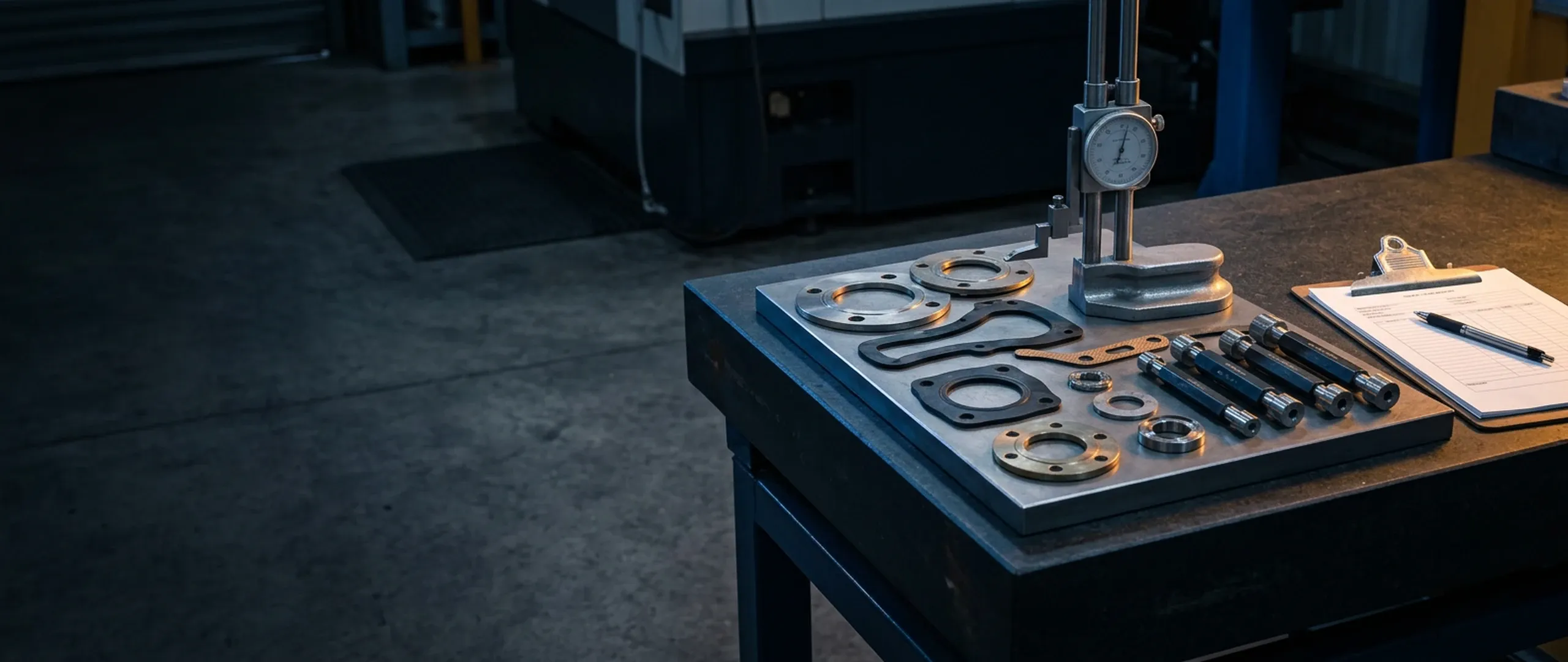
The first part from each setup is inspected against the drawing to verify dimensional conformance. This is an operator-level verification using calibrated instruments. No formal report is generated. Deficiencies are corrected before production continues.
Suitable for: general-purpose sealing, non-critical applications, repeat orders with established tooling.
First Article Inspection with Formal Report
On request
The first article is inspected and formally documented. The report includes all measured dimensions compared against drawing tolerances, pass/fail status, date, and inspector identification. A copy is provided to the customer with delivery.
Suitable for: quality records, audit trails, regulated industry supply, new product introductions.
Sampling Inspection
On request
A defined number of parts from the production batch are formally inspected against specified dimensions. Sampling provides statistical confidence in batch conformance without the cost or time of inspecting every individual part.
We can work to progressive checks (every 50th gasket, timed intervals, one part per sheet) or formal statistical sampling plans based on an Acceptable Quality Limit (AQL) standard such as ISO 2859-1 (the international standard for sampling inspection by attributes). Documented results are provided with your order.
Suitable for: larger production runs, statistical quality assurance, supply to regulated industries, ongoing scheduled orders.
100% Inspection
On request
Every part in the batch is individually inspected against specified dimensions. Documented results are provided. This level of inspection is typically applied to specific critical dimensions rather than every dimension on a drawing — this is both more practical and more meaningful.
Suitable for: small batches of critical components, safety-critical applications, defence and aerospace, medical devices.
First Article Inspection (FAI)
A First Article Inspection is the verification of the first part produced from a new setup against the customer's drawing or specification. Its purpose is to confirm that the manufacturing process, tooling, and material will produce parts that meet requirements before the full batch is manufactured.
Our default
Internal FAI
- ✓ Performed on every standard production order
- ✓ Operator inspects first part against drawing
- ✓ Dimensional check using calibrated instruments
- ✓ Deficiencies corrected before production continues
- — No formal report generated
- ✓ Included in standard pricing
On request
Documented FAI
- ✓ Formal inspection report generated
- ✓ All drawing dimensions measured and recorded
- ✓ Measured values compared against tolerances
- ✓ Pass/fail determination documented
- ✓ Report provided to customer with delivery
- ✓ Additional service — quoted at time of order
A Note on AS9102
AS9102 defines a structured First Article Inspection process using three standardised forms — covering part number, product, and characteristic accountability. Our standard documented FAI provides dimensional verification reporting. If your procurement requirements specifically call for AS9102-format FAI documentation, please advise us at the time of enquiry so we can discuss the scope and ensure all required elements are addressed.
Communicating Critical Dimensions
Not every dimension on a drawing is equally important. In many gasket applications, sealing performance is primarily governed by one or two key dimensions — typically the inner diameter (ID) that must clear a bore or pipe, or the outer diameter (OD) that must sit within a flange. Identifying and communicating these critical dimensions means we can apply enhanced inspection where it matters most, without unnecessary cost on non-critical features.
Criticality Is About the Tolerance, Not Just the Application
A common assumption is that every dimension on a part destined for a critical application must itself be critical. In practice, criticality is about how much a specific dimension affects function — not the severity of the end use alone.
Consider a full-face soft-cut gasket for a bolted flange. The ID is functionally critical — too small and it protrudes into the bore, too large and it exposes the flange face to the process media. The OD must fit within the flange outer edge. Thickness governs compression and seal against the flange faces. These are the dimensions that determine whether the gasket performs.
But the bolt hole diameters? Their only job is to let the studs pass through during assembly. A bolt hole drilled half a millimetre oversize or undersize changes nothing about sealing performance. That feature tolerates a much wider band, and requesting 100% inspection of bolt hole diameters adds cost without adding value.
Matching inspection intensity to dimensional criticality is standard quality engineering practice. It concentrates effort where it affects seal performance and avoids unnecessary cost on features with wide functional tolerance bands.
Note: criticality can change with context. The same gasket dimension that is non-critical in a bolted flange assembly could become critical in a confined groove joint. The classification is always application-specific — and it is your responsibility as the customer to communicate which dimensions matter most.
How to Mark Critical Dimensions
There are several accepted methods for communicating which dimensions require tighter control or enhanced inspection. We accept any of the following:
1. Circle them on the drawing
The traditional and most universally understood method. Draw a neat obround tightly around the dimension value itself — no per-dimension label or leader line is needed. The convention is explained once in the title block with a note such as CIRCLED DIMENSIONS ARE CRITICAL, which keeps the drawing face uncluttered while leaving no ambiguity about which dimensions matter.
2. Add a note on the drawing
Add a note near the relevant dimension such as CRITICAL DIMENSION — 100% INSPECT or VERIFY ID ON ALL PARTS. A general note in the title block or notes section referencing specific dimension callouts also works.
3. Specify in your email or purchase order
If you cannot mark up the drawing, include a line in your email or purchase order such as: Please inspect ID to ±0.1 mm on all parts or Critical dimension: ID 50.0 mm, verify 100%. The key is clear, unambiguous communication.
4. Use individual tolerance callouts or GD&T
If your drawing uses Geometric Dimensioning and Tolerancing (GD&T) or applies individual tolerances to specific dimensions (rather than relying solely on the general tolerance block), those individually toleranced features will be treated as requiring specific verification. Individual tolerances always take precedence over the general tolerance class.
Practical Example
A customer orders 200 ring gaskets with OD 100 mm, ID 80 mm, thickness 3 mm. The gasket must seal against a bore of 80.5 mm — so the ID is critical and must not exceed 80.3 mm. The customer circles the ID dimension on the drawing and notes ID critical — 100% inspect. We then measure the ID on every part, while the OD and thickness are verified by standard first article and in-process checks.
Quality Documentation
We provide a range of quality documentation depending on your requirements. All documentation is arranged at time of order to ensure the appropriate records are created during the manufacturing process.
Certificate of Conformance (CofC)
Compliance declaration
Also known as: Certificate of Compliance, CoC, or cert of conformity.
What: A formal declaration that the supplied goods conform to the purchase order and/or drawing specification.
When: Commonly required by regulated industry customers, or for any order where formal quality evidence is needed for audit or acceptance purposes.
Content: States the order and drawing reference, material, quantity, and that the goods conform to specification. Signed by a quality representative.
Certificate of Analysis (CoA)
Non-metallic material test data
Also known as: Batch analysis certificate, material analysis report, or compound analysis.
What: A document from the material manufacturer or an accredited laboratory stating the measured chemical and physical properties of a non-metallic material batch — typically PTFE, elastomer compounds, graphite, and fibre-based sealing materials.
When: Required for material traceability, regulatory submissions (food, pharmaceutical, potable water), or when non-metallic material properties must be independently verified against a specification.
Content: Batch or lot number, test results, test methods, and comparison against specification limits. May reference compliance with standards such as FDA 21 CFR 177.1550, EC 1935/2004, or 3-A Sanitary where relevant.
Inspection Report
Dimensional verification
Also known as: Dimensional inspection report, QC report, or measurement report.
What: A formal record of dimensional inspection results for the manufactured parts.
When: Required when documented evidence of dimensional conformance is needed for quality records, customer acceptance, or regulatory compliance.
Content: Drawing dimensions, measured values, tolerances, pass/fail status, inspector identification, and date.
Material Test Report (MTR)
Metallic material certification
Also known as: Mill Test Certificate (MTC), mill certificate, or "mill cert".
What: A document from the steel mill or metal supplier certifying the chemical composition, mechanical properties, and processing records for a specific batch of metallic material.
When: Required for metallic gasket components — spiral wound windings, inner and outer rings, ring-type joints (RTJs), jacketed gasket cores, and metal eyelets — where material grade verification is required by the end-use specification. Typically issued against ASTM (or the equivalent ASME Section II reprint) or EN material standards.
Content: Heat or lot number, chemical composition, mechanical test results (tensile, yield, hardness), and the applicable material specification (e.g. ASTM A240 316L).
EN 10204 Inspection Document Types
Many regulated-industry buyers request metallic material certification to a specific type defined by EN 10204:2004 (the European material certification standard). This is commonly requested for pressure equipment designed to AS 1210, AS 4041, or PED 2014/68/EU, as well as oil & gas, nuclear, and pharmaceutical work. The four types differ in who signs the certificate and whether the test results relate to the actual batch supplied or to representative samples from the same production process.
| Type | Issued By | Testing Scope | Typical Use |
|---|---|---|---|
| 2.1 | Manufacturer | Non-specific — declaration of compliance only, no test data | General industrial orders where a written statement of conformance is sufficient |
| 2.2 | Manufacturer | Non-specific — test results from representative samples of the same production process, not the batch shipped | Commercial-grade work where typical material properties need to be documented |
| 3.1 | Manufacturer, signed by an authorised inspection representative independent of the manufacturing department | Specific — tests performed on the actual batch supplied | The most commonly requested type for regulated industries |
| 3.2 | Manufacturer plus an independent third party (purchaser's inspector or notified body) | Specific — tests on the actual batch, countersigned by an independent authority | Nuclear, high-integrity pressure equipment, and customer-witnessed acceptance |
"Specific" testing means the results apply to the exact batch you receive. "Non-specific" testing means the results come from representative samples of the same production process. When specifying an EN 10204 type on a purchase order, confirm whether the requirement applies to the raw material (mill certificate) or the finished gasket component.
Request Documentation at Time of Order
Quality documentation — including Certificates of Conformance, Certificates of Analysis, Material Test Reports, and inspection reports — must be arranged before manufacturing begins. In most cases, we cannot retrospectively generate certificates or inspection records for orders that have already been dispatched. Include your documentation requirements on the purchase order or advise our sales team at the time of enquiry.
Material Traceability & Control
For many applications, knowing exactly what material was used — and being able to prove it — is as important as the dimensional accuracy of the finished part. We maintain material traceability systems that link finished products back to incoming material batches.
Batch Traceability
Each material batch received is identified with a unique lot or batch number. This number follows the material through cutting and production and can be recorded on delivery documentation when required. For orders where traceability is specified, we provide a chain of documentation from the material supplier through to the finished product — linking material certificates, production records, and inspection results to a single traceable batch.
Shelf Life & Environmentally Controlled Materials
Some materials degrade over time or when exposed to heat, moisture, UV radiation, or ozone. Certain specifications — particularly in aerospace, defence, and medical applications — require materials to be used within a defined shelf life from the date of manufacture or cure. We maintain controlled storage conditions for such materials and can provide cure date and manufacture date documentation on request.
Examples include: rubber compounds with shelf life requirements per ISO 2230 or MIL-HDBK-695, adhesive-backed materials, uncured or partially cured compounds, and moisture-sensitive materials requiring sealed storage.
Specify Shelf Life Requirements Early
If your specification requires controlled shelf life materials, advise us at the time of enquiry. We will confirm material availability, remaining shelf life, and storage conditions to ensure the material meets your requirements at the time of delivery.
Production Handling & Packaging
Different applications have different handling requirements. We can adapt our production handling, packaging, and storage practices to suit your application — whether that means managing how parts are handled during manufacturing, how they are packaged for delivery, or how materials are stored prior to use.
Common considerations include:
- • Products that need to be kept free from specific contaminants such as oils, silicone, or particulates
- • Components requiring individual wrapping, bagging, or labelling
- • Applications with specific packaging or preservation requirements
- • Orders requiring separation or segregation during production
Discuss Your Requirements Early
If your application has specific handling or packaging requirements, let us know at the time of enquiry so we can discuss what we can accommodate and plan it into the production process.
Contact Our TeamArranging Extended Quality Control
Most orders require nothing beyond a drawing — our standard quality controls apply automatically. If your application needs more, the options outlined throughout this guide are available on request. Here is how it works in practice.
Most orders
Send Us a Drawing
For the majority of orders, all you need to provide is a drawing or specification. Our standard quality controls apply automatically — the same default controls described earlier in this guide. No additional paperwork, no special requests needed.
If you need more
Additional Options Available on Request
If your application calls for it, we can also provide any of the following — just let us know at the time of enquiry or include it on your purchase order:
- • Formal inspection reports with measured dimensions and pass/fail results
- • Certificates of Conformance, Certificates of Analysis, or Material Test Reports
- • Tighter tolerances or specific inspection on critical dimensions
- • Sampling inspection or 100% inspection of specified features
- • Material batch traceability documentation
- • Adapted handling, packaging, or storage arrangements
For regulated industries
Quality Plans & Supplier Requirements
If you operate under a quality management framework or have specific supplier requirements, we can review your quality plan, inspection and test plan, or supplier specification and confirm what we can support. Just include it with your enquiry — we are happy to discuss the scope and tailor our approach to suit.
Not Sure What You Need?
We can help you work out the right level of quality control for your application. Whether you just need a certificate with your delivery or you have a full inspection and test plan to satisfy, get in touch and we will talk you through the options.
Contact Our TeamFor an overview of our quality management systems and certifications, see our Quality Assurance page.
Explore Further
Disclaimer
This guide is provided for general engineering reference only and does not constitute professional advice, specification, or guarantee of performance. Actual results depend on specific application conditions. Universal Gaskets Pty Ltd accepts no responsibility or liability for decisions made based on this information. For full terms, see our Terms & Conditions.
Actual inspection scope, documentation, and quality controls are confirmed on a per-order basis according to the requirements communicated at time of enquiry. Where inspection requirements are not specified at time of order, no quality outcome is implied beyond our standard inspection level. This guide is not a quality specification or contractual commitment.