
Expansion Joints
Expansion Joints
Rubber, Metal & Fabric Bellows
Without expansion joints, thermal growth, vibration, and pipe misalignment overload your flanges, pumps, and fixed equipment. We supply pipe expansion joints in rubber, metal, and fabric, in stocked and custom sizes, matched to the movement each line has to absorb: axial along the pipe axis, lateral sideways offset, or angular bending. Rubber bellows are the workhorse for water and HVAC, though they top out around 110 °C; past that you're into metal or fabric territory.
Types & Variants
Rubber Single-Arch Bellows
One wide convolution over a fabric-ply carcass, with embedded metal rings or wire for radial strength and vacuum resistance. The open arch suits pump suction and abrasive slurry, where solids will not pack a tight profile. Elastomer chosen for the medium: EPDM for water, nitrile for oils, neoprene for general and marine, gum rubber for slurry.
Rubber Multi-Arch Bellows
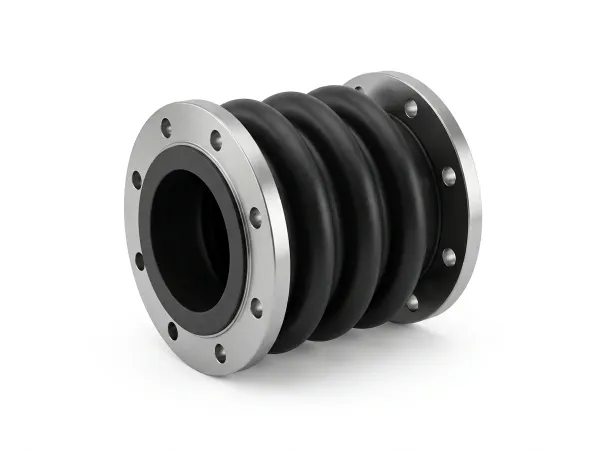
Double- and triple-arch profiles. Each added arch gives more axial movement for the same face-to-face length, so a multi-arch joint absorbs larger thermal growth or misalignment than a single arch in the same space. Same carcass and elastomer options as the single-arch joint.
Single Axial Metal Bellows
A stainless bellows for axial movement and vibration on hot or high-pressure lines beyond rubber's ceiling. This expansion bellows carries no pressure thrust of its own, so the pipe either side has to be anchored and guided to take that load.
Tied, Universal & Hinged Bellows
Restrained metal configurations that take lateral offset and angular movement while containing the pressure thrust in the hardware. Tie rods hold a single bellows against thrust for lateral duty; a universal joint runs two bellows on a centre spool for larger offsets; hinged and gimbal units carry angular movement in one plane or any plane, and route thermal growth around the pipe run.
Fabric Composite Joints
Multi-layer belts built from a gas-tight film barrier, insulation, woven structural fabric, and wire mesh, for large duct movements at low, near-atmospheric pressure. Standard composite belts run up to ~540 °C (1000 °F); a PTFE-coated fibreglass belt is held to the PTFE film's limit near 327 °C. Suited to ducting, flue gas, boiler outlets, and gas-turbine exhaust rather than pressurised pipe.
PTFE & PTFE-Lined Joints
Two related products for aggressive chemical media: a moulded all-PTFE convoluted bellows, and a rubber or metal joint with a bonded PTFE liner. Both put a fully fluorinated surface in contact with the fluid. The trade-off is lower pressure and temperature, and less movement, than a reinforced rubber joint.
Common Applications
Pump Suction & Discharge
Fitted on the suction and discharge of pumps to isolate vibration and take up misalignment. On mining slurry lines, gum-rubber tube compounds resist abrasion and a wide single-arch keeps solids from packing the convolution. Rubber joints also hold full vacuum on the suction side.
Water & Wastewater
Absorb thermal movement, ground settlement, and pump vibration across treatment plants and mains. EPDM is the usual elastomer, and AS 4087 sets the flange drilling for water and wastewater service.
HVAC Chilled & Condenser Water
Double-sphere EPDM joints around pumps and chillers in chilled water, hot water, and condenser loops, typically rated −20 to +120 °C. They cut the pump vibration and noise that would otherwise travel into the building pipework.
Flue Gas & Ducting
Fabric joints take up large movements in flue-gas ducts, boiler outlets, and gas-turbine exhaust, where pressures stay near atmospheric but temperatures and duct sizes rule out a metal bellows.
Process & High-Temperature Piping
Metal bellows handle thermal growth in steam, hot oil, and high-temperature chemical lines past rubber's limit. The configuration, whether tied, hinged, or gimbal, routes the growth and keeps pressure thrust out of the connected equipment.
Materials & Standards
Materials
- EPDM rubber (standard for water and HVAC service)
- Nitrile (NBR) rubber (oils and hydrocarbons)
- Neoprene (general, marine, and chemical service)
- Natural rubber (gum grade, for abrasive slurry lines)
- 304 and 316 stainless steel bellows
- Multi-layer fabric composite (film barrier, fibreglass, wire mesh)
- PTFE (all-PTFE bellows and bonded liners)
Standards
- EJMA Standards (11th Edition) — design and application of metallic bellows
- ASME B31.3 Appendix X — bellows joints in process piping (adopts EJMA)
- FSA Piping Technical Handbook — rubber and non-metallic expansion joints
- AS 4087 flange drilling — water and wastewater service
Related Products
Isolation Sleeves
Bolt Insulating Sleeves & Washers
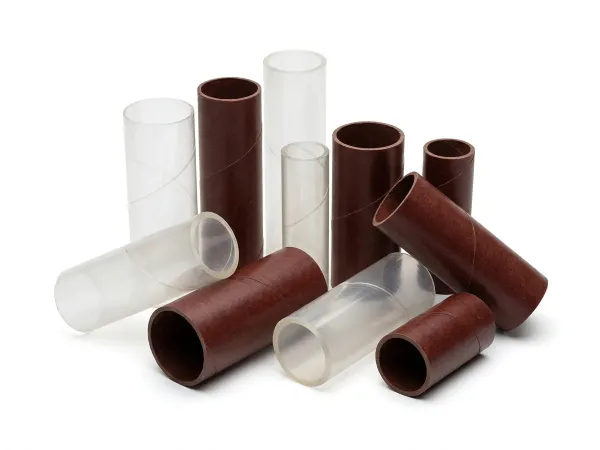
Individual insulating bolt sleeves and washers in Mylar, HDPE, and Nomex for flange isolation and cathodic protection systems.
Explore Product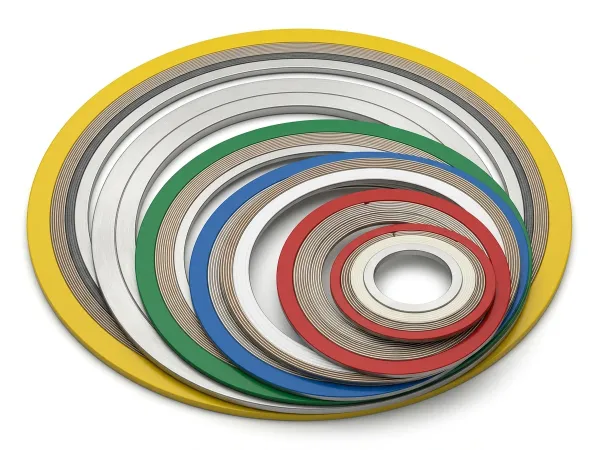
Metal Gaskets
Spiral Wound, Ring Joint, Kammprofile, Jacketed
Metallic and semi-metallic gaskets for high-integrity flanged connections — Spiral Wound, Ring Joint, Kammprofile, and Jacketed types for petrochemical, refinery, and high-pressure pipeline service.
Explore Product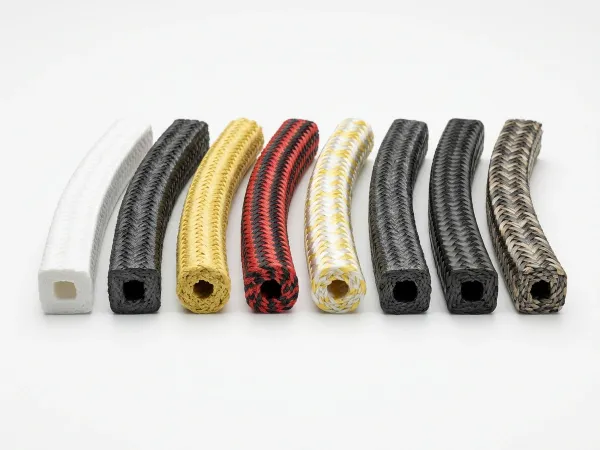
Compression Packing
Braided Packing for Pumps & Valves
Braided packing in PTFE, graphite, aramid, and hybrid constructions for pumps, valves, and rotating equipment.
Explore ProductRelated Guides & Resources
Explore Further
Need Expansion Joints?
Pipe size, media, temperature, and how much movement you need to absorb. Standard sizes ship from stock; custom-engineered joints are built to order.
Request a QuoteDisclaimer
This page is provided for general engineering reference only and does not constitute professional advice, specification, or guarantee of performance. Actual results depend on specific application conditions. Universal Gaskets Pty Ltd accepts no responsibility or liability for decisions made based on this information. For full terms, see our Terms & Conditions.