
How to Select a Gasket
A structured overview of the key factors that drive gasket selection. This guide won't make every decision for you. It will help you ask the right questions and know where to look for the answers.
Why Gasket Selection Matters
A gasket is a compressible element placed between two mating surfaces to create a static seal. Its job is deceptively simple: prevent leakage. But choosing the right gasket is anything but simple, because a gasket never works alone. It is part of a bolted flange joint system where the gasket, flange, bolts, and operating conditions all interact.
Change one element and the entire balance shifts: a different bolt material, a higher operating temperature, a new process chemical. This is why gasket selection is an engineering task, not a procurement task.
Hover or tap any element to see how it contributes to the seal.
The sealing element. It must deform enough to fill the flange's surface irregularities without being crushed by the bolt load or chewed up by the process fluid.
The rigid boundary. Flange face geometry, surface finish, and stiffness all constrain which gaskets can be used and how much bolt load the joint can carry.
The load source. Bolts apply the stress that seats the gasket and resists internal pressure — too little and the joint leaks, too much and the gasket crushes or the flange yields.
Temperature, pressure, media, and cycling. The operating environment dictates material limits, stress relaxation, and which failure mode the joint is most likely to experience.
The Goal
To achieve a bolt load high enough to seat the gasket and maintain a seal under operating conditions, but not so high that it damages the gasket or deforms the flange.
The Challenge
The acceptable bolt load range is a window defined by the gasket's minimum seating stress on one side and the gasket's crush or flange yield on the other. Everything in this guide helps you find that window.
The Selection Framework
This guide doesn't answer every question — it helps you identify what information to gather and where to find it. Selecting the right gasket follows four core steps, applied iteratively.
- Service Conditions — fluid chemistry, temperature, pressure, and the mechanical duty cycle.
- Gasket Family — soft-cut, semi-metallic, or metallic, based on the service envelope.
- Joint Design — flange face geometry, surface finish, bolt load, and material compatibility.
- Standards — pressure class, gasket factors, and assembly procedure.
Constraints found in Step 3 often require revisiting Step 2 — that iteration is normal. Every gasket selection runs through these same questions; only the complexity changes between a DN 50 water line and a Class 2500 steam header.
Step 1: Define Your Service Conditions
Gasket selection starts with the service environment: fluid chemistry, temperature, pressure, and the mechanical duty cycle of the joint.
Service Condition Checklist
Select the conditions that apply to your application. We'll suggest which gasket families suit your service.
Suggested Gasket Families
This is a general indication only. Final selection must account for the full joint system. Contact us for specific recommendations.
Key Service Condition Parameters
- Temperature: operating, design, max excursion, min ambient, thermal cycling rate
- Pressure: operating, design, hydro test, vacuum, spikes, pulsation
- Media: primary process fluid, phase, concentration, contaminants, pH, cleaning agents
- Cycling & Dynamics: thermal cycling, pressure pulsation, vibration, external loads
- Special Requirements: fugitive emissions, fire-safe, oxygen service, FDA, ATEX
Gathering this information before you start looking at gasket catalogues will save significant time. If you don't know the answer to any of these questions, that's a gap worth flagging with your engineering team before proceeding.
Workshop Note
In our experience, the most commonly overlooked service condition is the cleaning cycle. We regularly see gaskets specified perfectly for the process fluid, only to fail within weeks because the CIP (clean-in-place) solution or steam sterilisation cycle was never considered. Always ask: "What else will this gasket see besides the primary process media?"
Explore Further
Step 2: Understand the Gasket Families
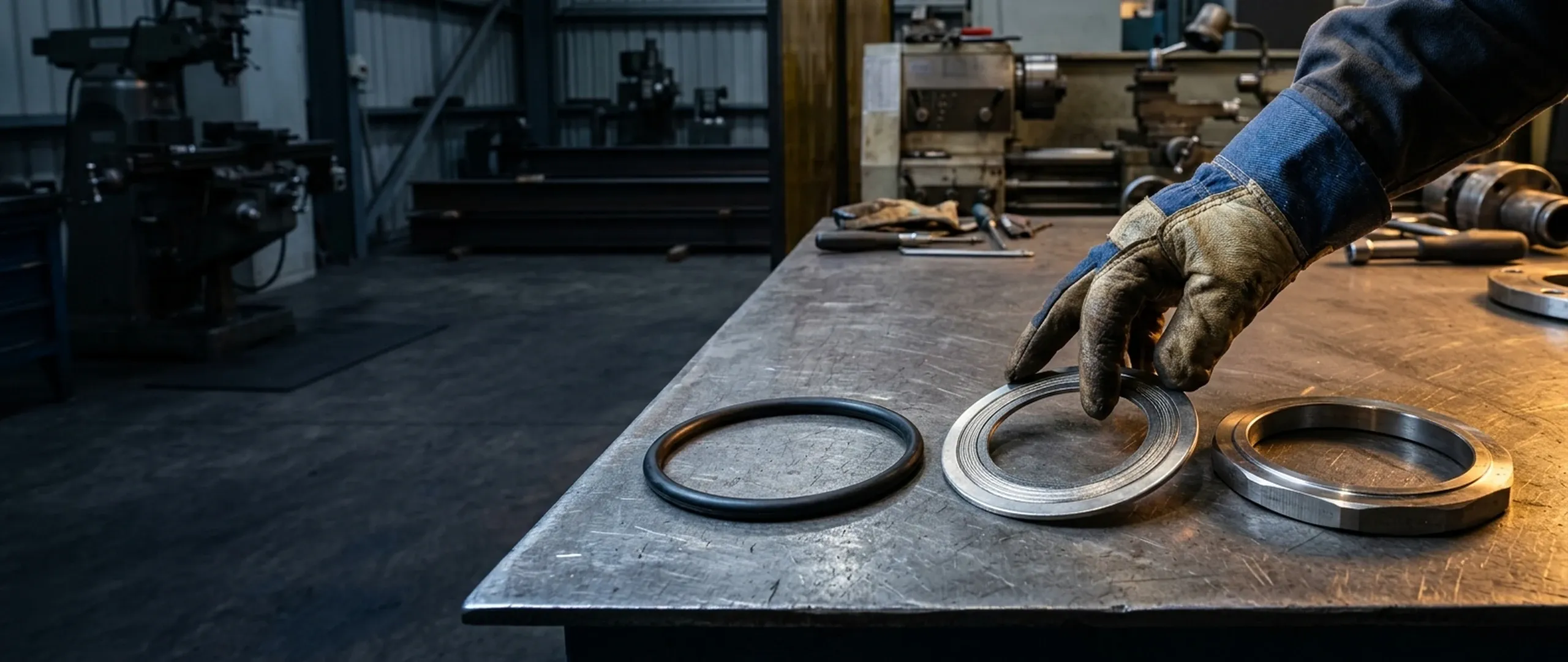
Gaskets broadly fall into three families. Each family has a different performance envelope, and choosing the right family is usually the first filtering step. That narrows your options from hundreds of products to a manageable shortlist.
Gasket Family Explorer
Select a family to see its members, capabilities, and best applications.
Gasket Families
Soft-Cut Gaskets
- Compressed fibre (non-asbestos)
- Rubber sheet (NR, NBR, EPDM, FKM, etc.)
- PTFE (virgin & filled)
- Graphite sheet (flexible)
Best for: Low to medium pressure, non-critical flanges, general chemical service
Semi-Metallic Gaskets
- Spiral wound (SWG)
- Kammprofile (grooved metal core)
- Metal-jacketed
- Corrugated metal
Best for: Medium to high pressure, elevated temperature, cyclic service, critical flanges
Metallic Gaskets
- Ring-type joint (RTJ)
- Solid metal flat rings
- Lens rings
- Delta / double-cone
Best for: Very high pressure, extreme temperature, API flanges, critical piping classes
Workshop Note
When a service falls in the overlap zone between gasket families, we almost always recommend the higher-capability option. We've seen too many cases where a soft-cut gasket was "just within range" on paper but failed under real-world thermal cycling or pressure spikes. The cost difference between a compressed fibre gasket and a spiral wound gasket is negligible compared to the cost of an unplanned shutdown. Our engineers can help you make this call if you're on the boundary.
Step 3: Consider the Joint Design
The gasket you choose must be compatible with the physical joint it sits in. The flange type, surface finish, bolt configuration, and available bolt load all constrain your options.
Flange Types and Compatible Gaskets
The flange face geometry determines which gaskets can physically be used. This is a non-negotiable constraint — you cannot use a raised-face spiral wound gasket in a ring-type joint flange.
| Flange Type | Common | Compatible Gaskets |
|---|---|---|
| Raised Face (RF) | Yes | Soft-cut, spiral wound (Style CG / CGI) |
| Flat Face (FF) | Yes | Full-face soft gaskets (must match bolt holes) |
| Tongue & Groove (T&G) | Specialist | Spiral wound (Style R / RIR), Kammprofile |
| Ring-Type Joint (RTJ) | Specialist | Metallic ring gaskets (R, RX, BX) |
| Male & Female (M&F) | Specialist | Spiral wound (Style R / RIR), soft-cut |
Key Joint Design Considerations
Surface Finish
Flange face roughness (measured in Ra or AARH) must be matched to the gasket type. Raised-face flanges with soft-cut gaskets typically run 3.2–6.3 µm Ra; metallic gaskets and RTJ grooves call for finer finishes, often under 1.6 µm Ra. A mismatched finish can prevent sealing regardless of bolt load.
Available Bolt Load
The bolt material, size, and quantity determine the maximum load you can apply. Some gasket types (e.g. metallic) need very high seating stresses that smaller flanges simply cannot deliver. Always check that the bolts can achieve the gasket's minimum seating stress.
Flange Rating & Class
Standard flanges (ASME B16.5, AS 2129, EN 1092-1) are rated for specific pressure-temperature envelopes. The gasket must be compatible with the flange class; not just the operating conditions.
Galvanic Compatibility
A gasket with a metallic component (spiral wound, Kammprofile, RTJ) must be electrochemically compatible with the flange material to prevent galvanic corrosion, especially in wet or conductive environments.
Step 4: Know Your Standards
If you don't know which standard your flange is designed to (ASME B16.5, AS 2129, EN 1092-1, or similar), your gasket selection has an unknown constraint. The table below covers the eight you're most likely to encounter. Each brings its own calculation methods, dimensional tolerances, and material acceptance rules.
| Standard | Scope |
|---|---|
| ASME B16.20 | Metallic gaskets (spiral wound, ring joint) for pipe flanges |
| ASME B16.21 | Non-metallic flat gaskets for pipe flanges |
| ASME PCC-1 | Guidelines for pressure boundary bolted flange joint assembly |
| EN 1514 | European flanges — non-metallic gasket dimensions |
| EN 12560 | European flanges — metallic gasket dimensions |
| AS 2129 | Flanges for pipes, valves and fittings (Australian table series) |
| BS EN 1514-2:2014+A1:2021 | Spiral wound gaskets (supersedes BS 3381) |
| API 6A | Wellhead and tree equipment (RTJ flanges) |
Gasket Factors (m & y)
ASME provides gasket factors m (maintenance factor) and y (minimum seating stress) for different gasket types. These are used in flange design calculations to determine if a flange can generate sufficient bolt load to seal a given gasket. Your gasket supplier should provide these values.
Assembly: ASME PCC-1
We've seen correctly specified gaskets leak within a week because of how they were tightened. ASME PCC-1 is the industry reference for bolt-up sequences: torque values, cross-pattern passes, and target stress.
Reference Table: Typical m and y Values
Indicative values for early-stage screening, consistent with ASME BPVC Section VIII Div 1, Mandatory Appendix 2, Table 2-5.1 and cross-referenced against Garlock, Klinger, and Flexitallic published data. y is the minimum stress (psi) required to seat the gasket; m is the multiplier applied to operating pressure for the residual-stress design check.
| Gasket type | m | y (psi) | y (MPa) |
|---|---|---|---|
| PTFE soft-cut, virgin (1.6 mm) | 2.75 | 3,700 | 25.5 |
| CNAF — 1.6 mm (1/16") | 2.75 | 3,700 | 25.5 |
| CNAF — 0.8 mm (1/32") | 3.50 | 6,500 | 44.8 |
| Flexible graphite sheet* | 2.00 | 900 | 6.2 |
| SWG — graphite filler, 316L windings | 3.00 | 10,000 | 68.9 |
| SWG — PTFE filler, 316L windings | 2.50 | 10,000 | 68.9 |
| Kammprofile (GMGC) — graphite, 316L core | 4.25 | 10,100 | 70.0 |
| Corrugated metal — soft iron, graphite | 3.25 | 5,500 | 37.9 |
| Double-jacketed metal — soft iron | 3.75 | 7,600 | 52.4 |
| Solid flat metal — soft iron / soft steel | 5.50 | 18,000 | 124 |
| RTJ — soft iron, oval / octagonal (R-series) | 5.50 | 18,000 | 124 |
| RTJ — 316 SS / Inconel 625 | 6.50 | 26,000 | 179 |
* Flexible graphite values are not in ASME Table 2-5.1; they are manufacturer-derived (Garlock, Klinger) industry consensus figures. ASME m and y values are non-mandatory recommended design constants, so designers may use other values if justified. Values may vary by ±10% across manufacturer datasheets for nominally identical products. Modern European gasket factors — determined by Pressure Vessel Research Council (PVRC) Room-Temperature Tightness Test (ROTT) methods and specified in EN 13555 (the European tightness-based calculation standard) — use different design parameters and are not interchangeable with ASME m/y. Always verify against the specific gasket supplier's published data for design-critical applications.
Common Pitfalls
Most gasket failures are not caused by the gasket itself. They're caused by the way it was selected, installed, or operated.
Over-tightening Bolts
Exceeding gasket maximum stress crushes the sealing element, causes blow-out, and can permanently deform the flange. Always use a calibrated torque wrench and follow the manufacturer's recommended bolt load.
Wrong Gasket Thickness
Thicker is not always better. Thicker gaskets can reduce pressure and temperature ratings, increase creep, and are more susceptible to blow-out. Use the thinnest gasket that will compensate for the flange surface irregularities.
Ignoring the System
A gasket doesn't work in isolation. The gasket, flange, bolts, and process conditions form a system. Changing one element (e.g. bolt material, flange class, operating temperature) can affect all the others.
Chemical Incompatibility
A material that works for water may disintegrate in a solvent. Always verify chemical compatibility for every medium the gasket will contact, including cleaning agents, flushing fluids, and trace chemicals.
Re-using Old Gaskets
Gaskets are single-use items. Once compressed, a gasket conforms to the actual surface irregularities of that joint. Re-using a gasket after a flange break will almost always result in a leak.
Skipping Torque Procedures
Uneven bolt load is the number-one cause of gasket failure. Always tighten in a cross-pattern (star pattern) sequence using multiple passes, and ideally with a calibrated torque wrench.
Workshop Note
Of all the failures we investigate, gasket reuse is the most frustrating because it is the easiest to prevent. We understand the pressure to get a plant back online quickly, but a reused gasket will almost never reseal reliably. The old gasket has already taken a permanent set to the specific surface irregularities of its previous installation. Our recommendation: always keep spare gaskets on hand for critical flanges so you're never tempted to reuse one.
Next Steps
The resources below cover the most common next moves: material shortlisting, chemical compatibility, and getting a quote.
Explore Further
Need Help With a Specific Application?
Send us your service conditions (media, pressure, temperature, flange type) and our engineers will come back with a specific gasket type, material grade, and any custom dimensions you need.
- We review your datasheet and service conditions
- We specify gasket type, material, and inner/outer dimensions
- We manufacture non-standard shapes and sizes in-house
Disclaimer
This guide is provided for general engineering reference only and does not constitute professional advice, specification, or guarantee of performance. Actual results depend on specific application conditions. Universal Gaskets Pty Ltd accepts no responsibility or liability for decisions made based on this information. For full terms, see our Terms & Conditions.
Gasket selection for pressure-containing equipment must be performed or verified by competent, qualified personnel in accordance with the applicable codes and standards for your jurisdiction and industry. This guide is not a substitute for formal engineering training, professional qualifications, or manufacturer-specific technical documentation.